
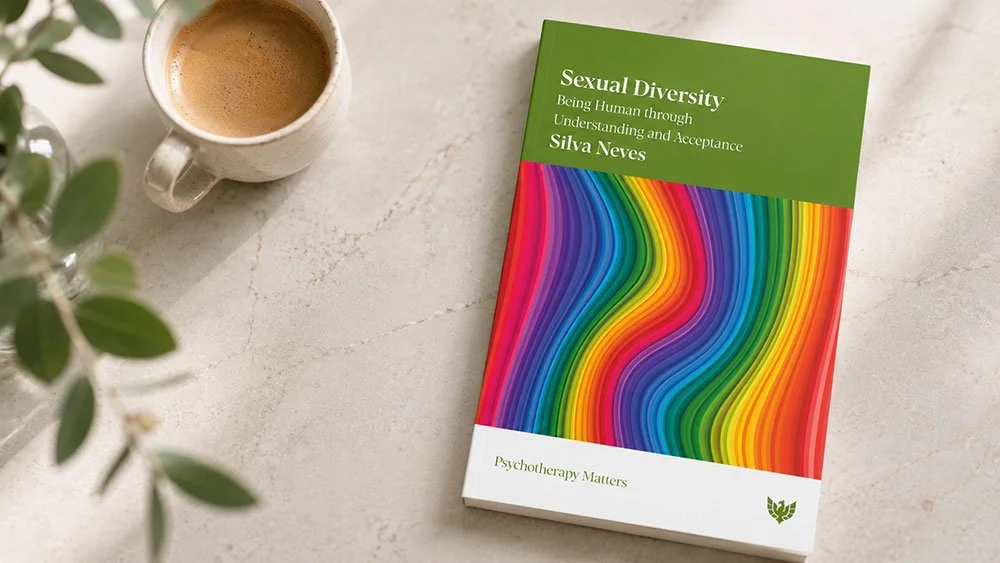
Sexual Diversity: Being Human Through Understanding and Acceptance is one of the most genuinely useful additions to a practising therapist's bookshelf to appear in recent years. Written by Silva Neves and published by Karnac Books as part of the UK Council for Psychotherapy's Psychotherapy Matters series, it is a compact, accessible guide to the full spectrum of sexual and erotic diversity. At 144 pages it is deliberately concise, yet it covers a remarkable amount of ground, from sexual orientation and gender identity to the often overlooked territory of erotic orientation.
What is the book about?
At its heart, this is a book about looking beyond assumptions. Neves invites the reader to step outside heteronormative narratives and to consider the wide variety of ways that people experience sexuality and eroticism. He explores heterosexual, lesbian, gay, bisexual, and queer identities, alongside the spectrum of erotic expression that runs from vanilla through to kink and fetish.
Crucially, the book argues that rigid sexual norms are limiting for everyone, including heterosexual people. Heterosexuality, as Neves points out, is not a single uniform experience. By grounding the discussion in intersectionality, he encourages therapists to hold curiosity rather than certainty when a client's erotic world enters the room.
Who is Silva Neves?
Silva Neves is an award-winning, COSRT-accredited and UKCP-registered psychosexual and relationship psychotherapist, as well as a trauma psychotherapist and a Pink Therapy Clinical Associate. He sits on the editorial board of the international journal Sexual and Relationship Therapy and has written widely for peer-reviewed journals and professional magazines. He is also the author of Compulsive Sexual Behaviours and Sexology: The Basics, and co-editor of Erotically Queer and Relationally Queer. In other words, this is an author writing firmly within his area of clinical expertise, which shows on every page.
What does Sexual Diversity cover?
The book is structured as a clear primer, moving logically through the territory it maps. Among the areas it explores:
Sexual expressions and the diversity of sexual orientations: including how minority stress affects wellbeing.
The diversity of erotic orientations: introducing concepts such as the erotic palette, the five cornerstones of eroticism, and erotic fantasies.
The diversity of sexual behaviours: covering the six principles of sexual health and how to explore a client's erotic mind safely.
Language and terminology: offering working definitions of identity terms while acknowledging that language is fluid and always changing.
What lifts the book above a dry glossary is its tone. Neves writes in plain English and a conversational style, and he brings the concepts to life with stories drawn from the consulting room and the wider world. The result reads less like a textbook and more like a thoughtful conversation with an experienced supervisor.
Why this book matters for therapists and counsellors
Many of us trained in an era when sexual and erotic diversity received little serious attention. That knowledge gap has real consequences. When a therapist assumes that a couple presenting as heterosexual is also monogamous and conventional in their eroticism, important parts of the clinical picture can go unexplored. Neves makes a persuasive case that awareness of sexual and erotic diversity deepens the therapeutic process and makes our consulting rooms genuinely available to clients who do not see themselves reflected in dominant norms.
For practitioners building or refreshing their practice, this is also a book that supports better outcomes. Clients are far more likely to do meaningful work with a therapist who signals openness and competence around sexuality from the outset.
Who should read it?
This is an essential read for practising psychotherapists, counsellors, and psychoanalysts, and it will be equally valuable to trainees, supervisors, and other professionals working in social care. Because it is written so accessibly, it also rewards any general reader who is curious to understand more about the variety of human sexuality. It would make a strong addition to any reading list on sex, relationships, or inclusive practice.
Our verdict
This is a small book with a large reach. It teaches a great deal while also creating space for honest self-reflection about our own assumptions. The writing is warm, the scope is generous, and the clinical relevance is immediate. We would happily recommend it to every therapist who wants to work more confidently and compassionately with the erotic lives of their clients. It is, quite simply, a gem.
Frequently asked questions
Is Sexual Diversity suitable for trainee therapists?
Yes. Its plain English style and clear structure make it an excellent introduction for trainees, while its depth still offers plenty to experienced practitioners.
How long is the book?
It is 144 pages, designed to be read comfortably in a few focused sittings.
Do I need a background in psychosexual therapy to follow it?
No. The book assumes no specialist training and explains its terms as it goes, although clinicians will find it especially useful for their practice.
Book details
Title: Sexual Diversity: Being Human Through Understanding and Acceptance
Author: Silva Neves
Series: Psychotherapy Matters (UKCP and Karnac Books)
Publisher: Karnac Books
Publication date: May 2025
Pages: 144
ISBN: 9781800133716
Formats and price: Paperback £19.99, eBook £15.99